
When you have spent months or even years navigating the heavy fog of depression, choosing a new treatment path can feel overwhelming. You’ve likely done the work: the daily pills, the therapy sessions, and the lifestyle changes, yet the relief you deserve still feels out of reach. If you’re feeling a mix of cautious hope and weary skepticism, please know that those feelings are completely valid. You aren’t being “difficult“; you are simply protecting your energy after a long and exhausting battle.
You don’t need more medical jargon or empty promises. You need to know whether there is a biological reason traditional treatments haven’t worked, and whether a different path actually exists.
Transcranial Magnetic Stimulation (TMS) isn’t just another “pill to try.” It is a non-invasive, scientifically backed way to reawaken the parts of the brain that depression has faded into dormancy. In this guide, we’re stepping away from the textbook definitions to explore the real human experience of TMS, helping you decide if this is the step that finally lifts the weight.
What Is TMS Therapy and How Does It Work?
To understand TMS, think of your brain as a complex, vibrant city grid. In conditions like depression, the power lines in certain neighborhoods, specifically the areas responsible for mood and motivation, have gone down. The infrastructure of who you are is still there, but the lights have been turned off.
TMS uses focused magnetic pulses to gently stimulate these specific circuits, helping to repair the connection and “turn the lights back on.”
Unlike medication, which must be processed by your stomach and circulated through your entire bloodstream, often affecting your liver, libido, and energy levels, TMS is highly targeted. It is a localized treatment that goes straight to the source of the “outage” without burdening the rest of your body. It isn’t a systemic chemical change; it is a precision-guided spark.
Which Conditions Does TMS Therapy Treat?
TMS is FDA-cleared primarily for Major Depressive Disorder (MDD), specifically for those who haven’t found the relief they need from antidepressants.
In clinical settings, this is often called “Treatment-Resistant Depression,” but at Mindfully, we prefer a more accurate term: “Medication-Resistant Depression.” This distinction matters. Why? We believe it wasn’t you that failed the treatment; rather, the medication failed to reach the specific circuits that needed help.
Beyond depression, TMS is also an effective option for:
- Anxious Depression: Addressing the intersection of heavy mood and racing thoughts.
- Obsessive-Compulsive Disorder (OCD): Helping to calm overactive circuits.
How TMS Differs from Medication and ECT
Understanding where TMS sits in the landscape of care can help you feel more confident in your choice.
Medication is a “systemic” approach. You can think of it like turning a master volume knob down on the entire house just to fix one specific channel on the TV. This is why you might feel the “numbing” side effects in your gut or a general sense of emotional fog.
ECT (Electroconvulsive Therapy) is a powerful tool for some, but it is invasive. It requires general anesthesia and involves induced seizures, which often necessitate a long recovery period and time away from daily life.
TMS sits in a unique, compassionate middle ground. It is:
- Non-invasive and fully awake: You remain conscious and comfortable throughout the session.
- Non-sedating: Unlike medication that might make you feel “flat,” TMS is designed to reawaken the brain.
- Seamless: Because there is no anesthesia, you can drive yourself to and from your appointments, keeping your daily routine intact while you heal.

Looking for an Alternative to Medication?
TMS offers a targeted, non-invasive approach without the systemic side effects of medication. If you’re exploring new options, we can help you understand how this treatment fits into your overall care plan.
What Do Patients Say About TMS Therapy Results?
When patients describe TMS working, they rarely talk about a sudden, overnight explosion of happiness. Instead, they describe a gradual, steady lifting of the weight.
You might notice that the “fog” separating you from the rest of the world begins to thin. Patients report that the physical heaviness pressing down on their chest starts to lighten. It’s often the small, quiet victories: laughing at a joke without faking it, feeling a genuine urge to listen to music, or getting out of bed without a mental battle that signal the shift. These aren’t just clinical markers; they’re signs of you rediscovering the whole you.
The Success Rates
While numbers can sometimes feel cold, the clinical data for TMS tells a story of genuine hope, especially when compared to traditional antidepressants.
- Response and Remission:Research shows that 50-60% of patients with medication-resistant depression experience a meaningful reduction in symptoms. Even more encouraging, 30-40% achieve full remission, meaning these symptoms are largely or completely resolved.
- Exceeding Expectations: In larger real-world registries, these success rates can be even higher, with some clinics reporting response rates up to 83%.
For a population that has often been told they are “out of options,” these figures represent a statistically superior path to healing compared to trying a third or fourth medication.
How Many Patients Say TMS Was “Worth It”?
The most important metric isn’t found on a chart; it’s found in the lives of the people who have walked this path. In surveys of TMS recipients, approximately 75% reported that the treatment was helpful, and the vast majority said they would choose it again or recommend it to a loved one.
For many, “worth it” means finally feeling present with their children or partners again, rather than watching life pass by from behind a glass wall. Even for those who don’t reach 100% remission, TMS often provides the “spark” needed to finally make therapy or other lifestyle changes effective.
The Timeline of Healing: What to Notice First
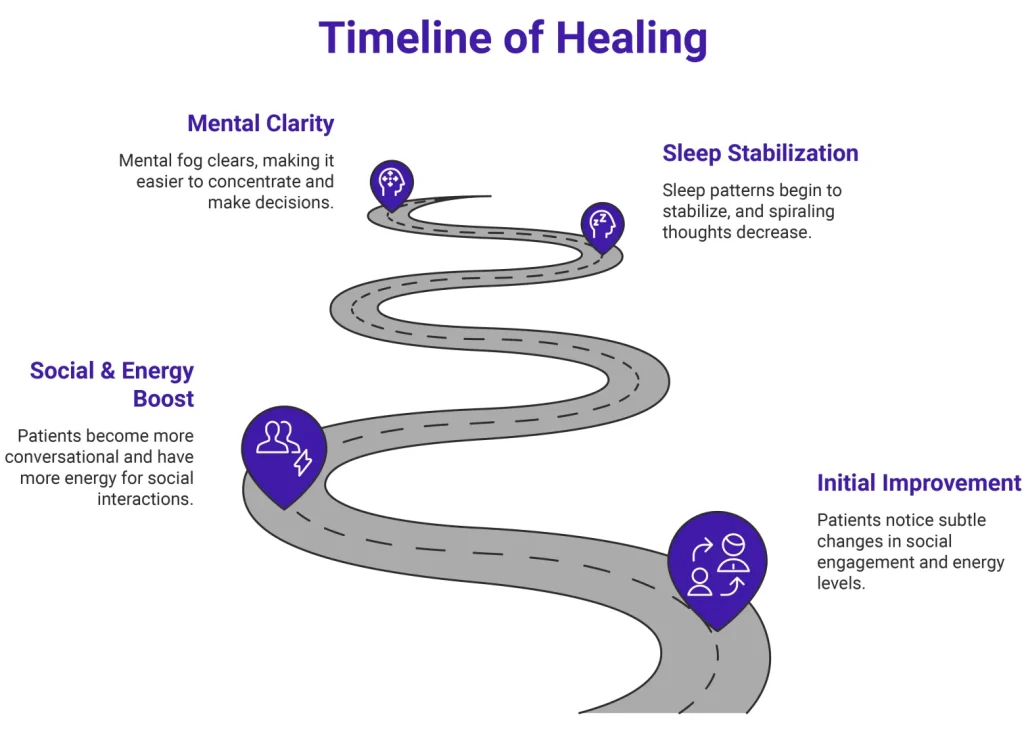
Improvement is a process of reconnection. While every brain is unique, most patients notice a shift between the second and fourth weeks of treatment. The first changes are often subtle; sometimes, your friends or family will notice them before you do.
- Weeks 2–3 (Social & Energy): You may find you are more conversational or have the energy to engage in small social interactions that previously felt exhausting.
- Weeks 3–4 (Sleep & Stabilization): Sleep patterns often begin to stabilize. The 3 AM spiraling thoughts become quieter, and the world feels a bit more manageable.
- Week 4+ (Mental Clarity): The mental fog begins to clear in earnest, making it easier to concentrate, make decisions, and feel like yourself again.
Durable Relief: More Than a Temporary Fix
One of the most common questions is: “Will this last?” The data suggest that TMS is not just a temporary “band-aid.” It encourages neuroplasticity, helping the brain strengthen its own mood-regulating circuits.
In clinical studies, about 90% of those who responded to TMS maintained their improvement at a 6-month follow-up. This suggests that for those who find relief with TMS, the benefits are durable, offering a long-term bridge to a healthier, more vibrant life.
Final Thoughts
Perhaps the most consistent pattern we see in patient reviews isn’t just a decrease in symptoms; it’s a profound sense of relief. This isn’t just relief from the weight of depression, but relief from the haunting guilt of feeling like you “weren’t trying hard enough.”
Real-world experiences consistently mirror the science: your struggle was never a character flaw. It has always been a biological reality. For the significant majority of people who thought they were out of options, TMS helped them realize that they didn’t need more “willpower“; they simply needed a different tool that could reach the circuits that medication couldn’t.
Healing is rarely a straight line; it can be messy and requires a commitment to yourself. But for those who choose this path, TMS often provides the spark needed to finally light the way forward.
If you see yourself in these descriptions and are tired of fighting a battle with tools that haven’t worked, we encourage you to reach out. You don’t have to keep struggling against a biological wall. Let the team at Mindfully help you bridge the gap between where you are today and the vibrant, clear life you deserve to lead.