
Before you are fully awake, something feels wrong. You check your calendar, email, and messages, but nothing explains it. At work, a meeting moves, and you assume bad news is coming. When a friend replies late, you reread the conversation and wonder whether you upset them.
By evening, none of what you feared came true, but you spent the day moving from one problem to the next. Each answer settles one worry until another appears. Even when nothing is actually wrong, your mind stays on alert, scanning for the next thing that could go wrong.
That constant sense that bad news is just around the corner can be exhausting, especially when you cannot point to anything specific causing it.
If this feels familiar, you may wonder why you expect trouble without a clear problem. Why do you always exhaust yourself every single day? Past experiences, stress, perfectionism, and anxiety can play a part. Understanding them can help you see why the feeling returns and what to do.
What Does It Mean to Always Expect Something Bad?
Expecting something bad is a kind of worry that begins before there is a clear problem. Your thoughts move ahead of what you know and fill the gaps with what might go wrong.
Sometimes those thoughts go straight to the worst outcome, a pattern often called catastrophizing. A meeting time changes and, within moments, you are imagining criticism, losing your job, and everything that might follow. The fear can feel convincing, but it doesn’t explain why it started. For that, it helps to look at what may be happening beneath the worry.
The important distinction is that the feeling of danger can appear before there is evidence of danger. You may notice a sense that something is wrong and then begin searching for an explanation. Once your mind finds one possible threat, it can start treating that possibility as something you need to prepare for, even when nothing has actually happened.
Why Do I Keep Expecting the Worst?
There is not always one reason you expect something bad to happen. The pattern can develop gradually, shaped by what you have experienced, the stress you are carrying, and how you have learned to respond to uncertainty. Understanding these influences can help you see why your mind keeps preparing for problems that haven’t happened.
Past Experiences Can Make You Expect Trouble
When bad news has caught you off guard before, staying alert can feel like a way to protect yourself. You may start watching for changes in someone’s tone, rereading messages, or preparing for conflict even when the situation in front of you does not suggest a problem.
A changed meeting may remind you of an earlier job loss. A delayed message may bring back the uncertainty of an unpredictable relationship. In moments like these, your reaction may be influenced by what happened before, not only by what is happening now.
Stress Can Make Problems Feel More Likely
Ongoing stress can make your mind more sensitive to anything that might go wrong. When you are already dealing with pressure from work, money, health, or caregiving, even a small unanswered question can feel harder to tolerate.
A routine meeting may suddenly feel like one more problem waiting to happen. When you have spent weeks or months dealing with one issue after another, your mind may stay prepared for the next one even after the immediate pressure has eased.
You Can Learn to Expect Problems From Others
Sometimes, expecting problems begins with what you see around you. If the people close to you often focus on danger, mistakes, or what could go wrong, you may have learned to treat worry as a way of staying prepared.
This does not mean someone caused your anxiety or that everyone from the same environment will respond in the same way. You may simply have learned that anticipating problems was normal or even responsible. You may not notice the cost of that habit until it begins following you into everyday situations.
Perfectionism Can Make Mistakes Feel Dangerous
Perfectionism can make uncertainty harder to tolerate because mistakes may feel like something you should have prevented. You may reread your work, rehearse conversations, or think through every possible outcome because you want to make sure nothing goes wrong.
That preparation can feel responsible at first, but it becomes exhausting when there is no clear point at which you have done enough. If the problem is only hypothetical, there is always another possibility to consider and another mistake you could try to prevent.
Anxiety Can Keep You Expecting the Worst
Sometimes, expecting the worst is part of a broader pattern of anxiety. This may be more noticeable when worry moves from one area of life to another, feels difficult to control, or continues even when there is no longer a clear reason for concern.
The feeling itself does not tell you what is causing it. What matters is also how often it happens, how long it lasts, and what it changes in your daily life. Understanding where the pattern may have started is useful, but it is also important to notice what you do when the worry appears, because those responses can help keep the cycle going.
How Checking, Reassurance, and Avoidance Keep the Cycle Going
The cycle often begins with an uncertain event and a frightening explanation. Because the discomfort feels urgent, you do something to settle it.
Before the meeting, you might reread emails, ask a coworker whether the manager seems upset, and prepare answers for imagined criticism. When nothing alarming appears, you feel better. Checking once may be practical, but repeated checking can make relief depend on doing it again.
Avoidance can work the same way. Canceling a plan or postponing a conversation may ease the fear now, but you never learn what would have happened. The next uncertain situation can restart the cycle, so what matters is how often it takes over and what it costs you.
When Does Worry Become a Problem
Everyone worries sometimes, especially during a real problem, major change, or stressful period. That worry usually has a clear subject and becomes easier to manage when the situation changes or you take a useful action.
Worry deserves closer attention when it spreads across many situations, feels hard to control, or begins affecting sleep, concentration, work, or relationships. NIMH estimates that 2.7% of U.S. adults experienced generalized anxiety disorder in a single year. Among those adults, 32.3% had serious impairment. Those numbers cannot tell you what your worry means, but they show why its effect on daily life matters. Another useful clue is whether the feeling is tied to something specific in front of you.
How Evidence Helps Separate Intuition From Anxiety
No feeling arrives with a label telling you whether it is intuition or anxiety. Intuition is not always calm, and anxiety can arise around a real problem. Instead of judging the feeling by its strength, start with what drew your attention.
Did someone say something that does not add up, cross a boundary, or create an immediate safety concern? Those details give you something specific to respond to. Anxiety is more likely to be leading when uneasiness comes first, and your mind begins collecting possible disasters to explain it, especially when the fear returns soon after reassurance.
If your manager identifies an error, you have a real issue to address. If the only information is a new meeting time and your thoughts jump to criticism, dismissal, and financial disaster, most of what is frightening you has not happened. The goal is not to talk yourself out of genuine concern. It is to choose a response that fits what you know so far.
What Can You Do When You Expect the Worst
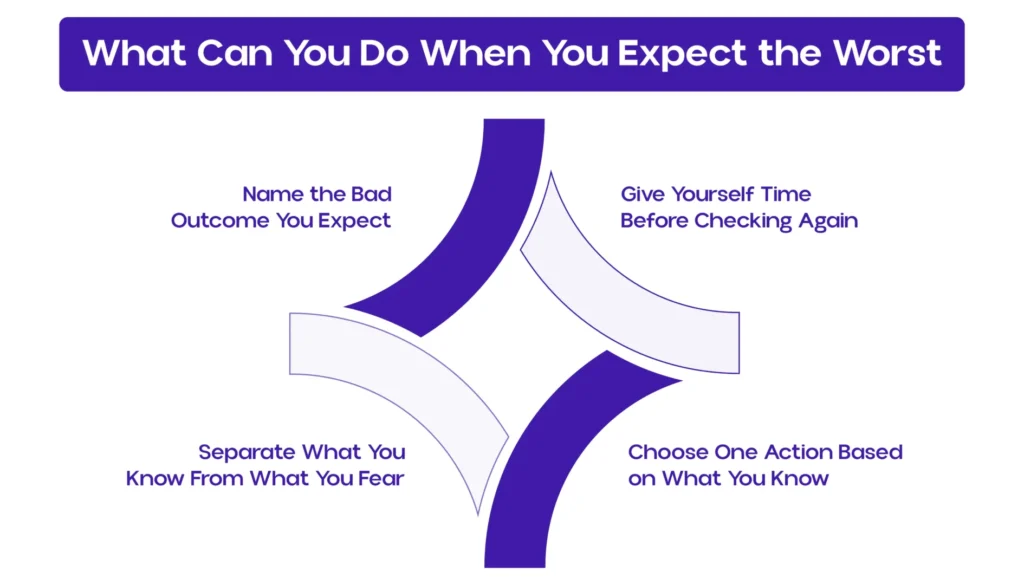
When fear feels urgent, even a short pause can be difficult. The goal is not to convince yourself that everything will be fine or dismiss the possibility that something could be wrong. Instead, slow down enough to separate what you know from what you are imagining and respond to the situation in front of you.
Name the Bad Outcome You Expect
Replace “Something bad is going to happen” with the outcome you are imagining: “I think this meeting is about a mistake.” This gives you one thought to examine instead of a feeling that everything is wrong.
Separate What You Know From What You Fear
Start with what you know: the meeting time changed, and no reason was given. Losing your job is something you fear, not something you know. Saying “I do not know why it moved” may feel uncomfortable, but it keeps the unanswered part of the situation from becoming bad news.
Choose One Action Based on What You Know
Ask what the situation actually needs from you now. You might review the meeting note or correct a mistake you already know about, then return to your work. If there is immediate danger, a significant health change, or a real deadline, get the appropriate help instead of waiting.
Give Yourself Time Before Checking Again
After one useful action, you may still feel a strong pull to check, ask for reassurance, or review everything again. See whether you can return to lunch, a conversation, or another task before acting on that urge. You are learning whether another check gives you useful information or only another short break from the fear. If this remains difficult to do on your own, that may be one reason support helps.
When Should You Seek Help for Repeated Worry
You do not have to wait until worry controls every part of your life. Professional support may be worth considering when the expectation is hard to control, keeps interrupting sleep or concentration, affects work or relationships, or leaves you feeling worn down. It may also help if you avoid important activities or spend much of the day checking, seeking reassurance, and preparing for problems that have not happened.
Therapy can help you understand both where the expectation comes from and what you do when it appears. Cognitive behavioral therapy may help you examine worst-case predictions and the checking or avoidance that follows them. Mindfully’s guide to cognitive behavioral therapy explains how this approach connects thoughts, feelings, and behavior. Acceptance-based approaches may help you make room for uncertainty while continuing to focus on what matters to you.
If the expectation began after trauma or is tied to distressing memories, a therapist may discuss trauma-focused treatment. Mindfully provides EMDR therapy for trauma-related concerns. A conversation about your history, symptoms, and goals can help determine whether that or another approach fits you.
But remember you do not have to eliminate uncertainty to feel better. With the right support, you can learn to understand what your worry is responding to, reduce the habits that keep it going, and move forward without treating every unknown as a sign that something bad is about to happen.